Credit Hours: 3
Course Description
This course introduces students to the concepts of integrated water resources management (IWRM) and their institutional arrangements for IWRM in Ghana. Specific topics addressed in the course are:
- Introduction to Integrated water resources management: What and why IWRM, dimensions of IWRM, approaches to IWRM.
- Status of water resources in Ghana.
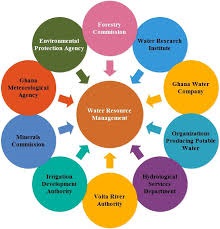
- Institutional arrangement for water uses and management in Ghana.
- Policies for water resource management in Ghana: Water Resources Commission Act; Ghana National Water Policy, Raw water guidelines; Water Use Regulations, Riparian buffer zone policy for managing freshwater bodies in Ghana, Drilling Licence and Groundwater Development Regulations, National Environmental Sanitation Policy, Environmental Protection Agency Act.
Course Objectives
At the end of the course student will be able to:
- Summarize the latest insights, context and concepts in integrated water management.
- Explain the main arguments for an integrated approach in the field of water management.
- Identify and understand the major stakeholders and their roles in the Management of water resource.
Reading Materials
- Ali, M.H. (2011). Practices of Irrigation and On-farm Water Management (Vol. 2). London: Springer. DOI: 10.1007/978-1-4419-7637-6.
- Loucks, D. P. (2006) Water Resources systems Planning and Management: Studies and Reports in Hydrology. The Netherlands: UNESCO Publishing.
- Yeleliere, E., Cobbina, S.J. and Duwiejuah, A.B. (2018). Review of Ghana’s Water Resources: The quality and management with particular focus on freshwater resources. Applied Water Science, 8, 93. Doi: 10.1007/s13201-018-0736-4.
Credit Hours: 3
Course Objectives
At the end of the course, the student will be able to:
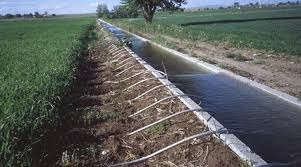
- Justify the need for irrigation and drainage
- Give advantages and disadvantages of different irrigation methods
- Understand the concepts of irrigation systems in Ghana
- Calculate irrigation water requirements of plants and cropped fields
- Solve problems relating to soil salinity and alkalinity of irrigated soils.
- Design surface and subsurface drainage system for agricultural land
Course Description
This course introduces students to the concepts of irrigation types and water requirements for a cropped field. The course begins with the need, advantages and disadvantages of irrigation and drainage. It provides students with the opportunity to appreciate the distinction and merits and demerits among different irrigations types and schemes applicable in the international and Ghanaian contexts. It also addresses the relationship among soil, water and plants. Students gain the needed competencies in estimating the irrigation water requirement of crops and a cropped field. Specific topics addressed in the course are:
- Introduction: Definition of irrigation, advantages and disadvantages of Irrigation, environmental effects, Ghana policy on irrigation and drainage, stakeholders involved in irrigation and drainage in Ghana.
- Soil -water - plant relationship: Soil and its function, physical properties of soil and their importance in relation to irrigation, classes and availability of soil water, movement of water in soils, measurement of soil moisture, crop growth and moisture relationship, salt problems in soil and effect of salts on plant growth.
- Irrigation Requirement: Evaporation, consumptive use and evapotranspiration, effective rainfall and irrigation requirements, water requirements of various crops, duty of water.
- Irrigation systems: types of irrigation systems, performance of irrigation systems, advantages and disadvantages of irrigations systems, frequency of irrigation, scheduling.
- Drainage of agricultural lands: Benefits of drainage, design concepts, design of surface and subsurface drainage systems.
- Land Development: Reclamation and management of saline and alkaline soils, waterlogging.
- Irrigation Management: Management of irrigation system, water charge assessment and water use management.
Reading Materials
- Sharma, R.K. (2017). Textbook of Irrigation Engineering and Hydraulic Structures. New Delhi: S. Chand and Co.
- Ministry of Food and Agriculture, Ghana (2011). National Irrigation Policy, Strategies and Regulatory Measures. Accra: Ghana Irrigation Development Authority, Ministry of Food and Agriculture. ISBN: 016031101213.
- Ali, M.H. (2011). Practices of Irrigation and On-farm Water Management (Vol. 2). London: Springer. DOI: 10.1007/978-1-4419-7637-6.
- Namara, R. E., Horowitz, L., Kolavalli, S., Kranjac-Berisavljevic, G., Dawuni, B. N., Barry, B., Giordano, M. (2010). Typology of irrigation systems in Ghana. Colombo, Sri Lanka: International Water Management Institute. 35p. (IWMI Working Paper 142). doi: 10.5337/2011.200.
- Asawa, G.L. (2008). Irrigation and Water Resources Engineering. New Delhi: New Age International.